Depending on operating conditions and volume, the following classes are distinguished:
To comply with fire and environmental safety measures, they must have a roof or a pontoon to prevent the evaporation of flammable petroleum products and, consequently, the release of harmful substances into the ambient air.
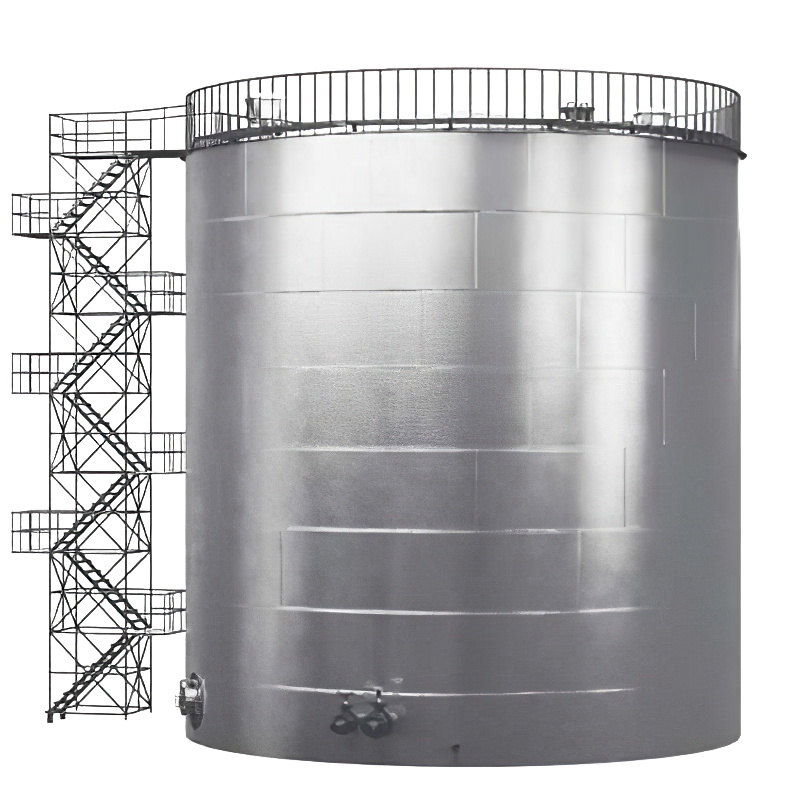
NIKOYLSERVICE manufactures vertical cylindrical tanks for storing petroleum products with volumes up to 50,000 m³ with a pontoon, floating, or fixed roof.
The selection of the cylindrical tank type is made at the design stage, depending on the stored product, the specific technological process of the enterprise, and the characteristics of the site where it will be installed.
There are 4 main types of vertical cylindrical tanks:
Used for storing products with relatively low volatility (with saturated vapor pressure not exceeding 26.6 kPa) and a flash point above 61°C. Most often, such cylindrical tanks store fuel oil, diesel fuel, domestic kerosene, bitumen, tar, oils (including food-grade), and water. Also, vertical cylindrical steel tanks with a fixed roof without a pontoon can be used for storing more volatile (with SVP up to 93.3 kPa) and highly flammable products. In such cases, the RVS tank is equipped with a gas piping system or a light fraction recovery unit.
Used for storing products with saturated vapor pressure within 26.6 – 93.3 kPa and a flash point below 61°C. Most often, they store crude oil, gasolines, kerosenes, and jet fuel. The pontoon is a rigid, gas-tight floating disc-shaped cover placed on the product surface inside the cylindrical tank so that at least 90% of its area is covered. The annular gap between the pontoon and the tank wall is sealed with a special sealing device. The pontoon serves to reduce the rate of saturation of the tank's vapor-air space with vapors of the stored product.
This tank design involves the use of a roof located on the surface of the stored product with full contact. The buoyancy of the roof is achieved through the use of sealed compartments or boxes. In an emptied vertical cylindrical tank, the roof rests on special supports mounted on the bottom. The rotation of the floating tank roof is prevented by using guide pipes. A disadvantage of the floating roof is the possibility of contamination of the stored product due to precipitation. There are also cases of the roof's sealing device freezing to the wall. The advantages of such a roof design include reduced product losses from evaporation.
This vertical tank design is used at production sites where it is not possible to construct a tank farm berm. Also, cylindrical tanks with a protective wall are built near water bodies and residential areas to ensure the safety of the environment and the population. The protective wall is installed to prevent product spills in case of depressurization of the primary tank.
NIKOYLSERVICE manufactures RVS tanks in accordance with TU-5265-002-694784422013 and holds the necessary Certificates of Conformity.
We produce RVS of any hazard class and any design.
For production, various grades of sheet steel are used depending on the chemical characteristics of the stored product and the climatic conditions at the operation site:
- St3sp - for climatic zones with a minimum temperature of -40°C
- 09G2S - for climatic zones with ambient temperatures below -40°C
- 12Kh18N10T - for storing food products, water, or acids, possesses high corrosion resistance
For the production of vertical tank bottoms of RVS type, steel with a thickness of at least 4 mm is used. In small volume tanks (up to 1000 m³ inclusive), the bottom is usually flat. For RVS with a volume of 1000 m³ or more, the tank bottom is manufactured with a slope from the center or towards the center. The slope is made at a ratio of 1 to 100. The most common is a conical base with a slope from the center, as this helps to avoid bottom sediment accumulation. An annular rim is installed on the bottom of RVS tanks with a volume greater than 1000 m³. The steel thickness for the rim is 6 mm or more, depending on the thickness of the lowest shell course of the RVS. The dependency is shown in the table:
|
Thickness of the lowest shell course |
Minimum thickness of the annular rim |
|
up to 7 mm (inclusive) |
6 mm |
|
8 mm – 11 mm (inclusive) |
7 mm |
|
12 mm – 16 mm (inclusive) |
9 mm |
|
17 mm – 20 mm (inclusive) |
12 mm |
|
20 mm – 26 mm (inclusive) |
14 mm |
|
26 mm and above |
16 mm |
The tank bottom is also often equipped with cleaning sumps. They are designed to drain bottom water, various deposits, and contaminants and are installed in a specially prepared pit. If the bottom slopes towards the center, the cleaning sump is located in the center of the bottom; if the slope is away from the center (or with a flat bottom design) – the sump is located near the wall at a distance of 600 mm or more. There are two types of sumps: round and trough.
The shell is a steel sheet, welded from rolled metal sheets in several courses. By the rolling method, the shell is prepared at the factory in the form of a rectangular sheet, welded from 1.5x6 m rolled metal sheets. Vertical joints of the sheets have a stagger, and longitudinal seams are prepared with a bevel for a serrated assembly joint. A technological allowance of up to 300 mm is left on the sheet, from which the serrated assembly joint is cut. For shell plate-by-plate assembly, rolled sheets with a width from 1.8 m to 3 m and a length up to 12 meters are used. Edge processing of the sheets is carried out mechanically (milling) or by plasma cutting on numerically controlled machines. Sheet rolling is performed on 3- or 4-roll bending machines.
The thicknesses of the shell courses are determined at the design stage of the vertical cylindrical tank to ensure the strength of the entire structure. The calculated shell course thicknesses may include a corrosion allowance (margin). GOST 52910-2008 provides for minimum structural thicknesses of vertical steel tank shell sheets (RVS) depending on their diameter:
|
Tank diameter |
Minimum shell sheet thickness |
|
up to 16 m (inclusive) |
5 mm |
|
16 m – 25 m (inclusive) |
6 mm |
|
25 m- 40 m (inclusive) |
8 mm |
|
40 m – 65 m (inclusive) |
10 mm |
|
65 m and above |
12 mm |
For the placement of manholes and nozzles in the shell of a vertical cylindrical tank, special openings are provided, which are equipped with a reinforcing pad around the circumference of the installed item (when installing items with a nominal bore greater than 70 mm). All RVS type tanks are designed with an access hatch in the first shell course. Vertical tanks with a floating roof (RVSPk) and with a pontoon (RVSP) are equipped with an additional access hatch for access to the pontoon or roof.
At the top of the cylindrical tank shell, the main annular stiffening ring is located. For RVSPk tanks with a floating roof, stiffening rings are installed on the outer side of the shell 1.1 m – 1.25 m below the top edge. The annular stiffening ring, in addition to its function of strengthening the tank structure, serves as a service platform.
Depending on the size and other specific features, vertical cylindrical tanks use fixed roofs, which are divided into frameless (self-supporting) and framed roofs of conical and spherical shapes, as well as floating roofs. Roofs are used to prevent air pollution by flammable vapors.
Frameless roofs are a conical or spherical decking sheet depending on the volume. Conical frameless roofs are installed for volumes from 100 m³ to 1000 m³, and spherical ones from 1000 m³ to 5000 m³.
Framed conical roofs are a load-bearing metal structure that is attached to the shell, and decking that freely rests on the frame. They have greater resistance to high dynamic loads and are used for volumes from 1000 m³ to 5000 m³. They are manufactured in an explosion-proof design, as they can function as an emergency valve in case of overpressure: instead of serious destruction and deformation, the decking tears off at the point where the frame is welded, since the decking itself is not attached to the shell. This ensures integrity.
Framed spherical roofs are used on larger vertical steel tanks from 5000 m³, but not exceeding 50 m in diameter. They are also manufactured in an explosion-proof design, as they can function as an emergency valve in case of overpressure: instead of serious destruction and deformation, the decking tears off from the wall. This ensures integrity.
Floating roofs are used with a maximum snow load of no more than 1.5 kPa and are specially mounted with a central ballast to create a slope towards the center, which prevents the working product from getting onto the surface.
Floating roofs can be single-deck or double-deck. The single-deck design has operational limitations: they are installed on a tank with a diameter of up to 50 m with a maximum wind load of 100 km/h. The double-deck is a reinforced version that has greater buoyancy.
They are used in conjunction with a fixed roof. A pontoon is a rigid disc made of steel or aluminum. It must cover at least 90% of the surface and be gas-tight to prevent loss of the working medium.
Summary table of technical characteristics of vertical steel tanks (RVS)
|
Volume, m³ |
100 |
200 |
300 |
400 |
500 |
700 |
1000 |
2000 |
3000 |
5000 |
10000 |
20000 |
30000 |
50000 |
||
|
Internal shell diameter, mm |
4730 |
6630 |
7580 |
8530 |
8530 |
10430 |
10430 |
15180 |
18980 |
22800 |
20920 |
34200 |
28500 |
39900 |
45600 |
60700 |
|
Shell height, mm |
6000 |
6000 |
7500 |
7500 |
9000 |
9000 |
12000 |
12000 |
12000 |
12000 |
15000 |
12000 |
17880 |
18000 |
18000 |
18000 |
|
Number of courses, pcs. |
4 |
4 |
5 |
5 |
6 |
6 |
8 |
8 |
8 |
8 |
10 |
8 |
12 |
12 |
9 |
8 |
|
Thickness of top course, mm |
5 |
5 |
5 |
5 |
5 |
5 |
5 |
5 |
6 |
6 |
7 |
8 |
8 |
12 |
12 |
11 |
|
Thickness of bottom course, mm |
5 |
5 |
5 |
5 |
5 |
5 |
6 |
6 |
8 |
10 |
12 |
10 |
13 |
18 |
22 |
25 |
|
Thickness of central part, mm |
5 |
5 |
5 |
5 |
5 |
5 |
5 |
5 |
5 |
5 |
5 |
5 |
5 |
5 |
6 |
8 |
|
Thickness of rims, mm |
- |
- |
- |
- |
- |
- |
- |
6 |
7 |
8 |
10 |
8 |
12 |
14 |
16 |
16 |
|
Decking thickness, mm |
4 |
4 |
5 |
5 |
5 |
5 |
6 |
4 |
4 |
4 |
4 |
4 |
4 |
5 |
5 |
5 |
|
Shell |
3638 |
5094 |
7277 |
8187 |
9824 |
12007 |
16410 |
25581 |
36385 |
48426 |
62930 |
86450 |
126243 |
261122 |
299500 |
409480 |
|
Bottom |
757 |
1467 |
1909 |
2409 |
2409 |
3582 |
3584 |
8205 |
12903 |
19052 |
17577 |
40756 |
33206 |
62606 |
102400 |
220649 |
|
Roof |
767 |
1549 |
2715 |
2882 |
2882 |
4726 |
5379 |
12380 |
19350 |
31700 |
25340 |
78619 |
51611 |
110000 |
136200 |
325047 |
|
Ladder |
950 |
950 |
950 |
950 |
950 |
1200 |
1200 |
1200 |
1200 |
1200 |
1200 |
1200 |
2300 |
5100 |
1830 |
20600 |
|
Roof platforms |
788 |
1104 |
1263 |
1421 |
1421 |
1737 |
1737 |
2257 |
3159 |
3795 |
3483 |
5692 |
5600 |
6642 |
8500 |
10102 |
|
Components |
1162 |
1162 |
1162 |
1442 |
1442 |
1772 |
1772 |
1772 |
1772 |
2512 |
4238 |
4631 |
4852 |
5294 |
5294 |
5294 |
|
Manholes and nozzles |
400 |
425 |
774 |
774 |
774 |
951 |
951 |
1077 |
1447 |
2460 |
2968 |
2986 |
2986 |
3561 |
6100 |
12384 |
|
Frames and packaging |
1100 |
1100 |
1100 |
1100 |
1300 |
1300 |
1700 |
3000 |
3400 |
5100 |
9600 |
10200 |
17550 |
24000 |
29600 |
52800 |
|
Total |
9562 |
12851 |
17150 |
19165 |
21002 |
27277 |
33433 |
55785 |
81359 |
113505 |
126792 |
230516 |
245835 |
477725 |
589424 |
1056356 |
*Overall dimensions are for reference and may vary depending on customer requirements
Metal structures can be manufactured in two ways: by rolling method or by plate-by-plate assembly.
The rolling assembly method involves factory manufacturing of steel blanks for bottoms, shells, and roof elements, their automatic or semi-automatic welding, and then assembly at the construction site. Traditionally, tanks up to 5000 m³ represent one roll, more than 10000 m³ — four rolls.
At the installation site, the rolls are unrolled: first, the shell roll is placed in a vertical position on the already unrolled bottom. Then it is unrolled and fixed in the design position. After that, the joints are welded and the coating is installed. The shell and bottom are joined by double-layer welding of internal and external seams.
The external surfaces can be covered with a thermal insulation layer - cladding made of aluminum or galvanized steel sheets with a thickness of 0.9 and 0.7 mm, respectively.
Small diameter bottoms are manufactured by the rolling method. In the production of large tanks, the peripheral part consists of individual elements that form a course, and the lowest course is attached to it.
This method involves the production of individual sheets of the required thickness and a maximum size of 2500x10000 mm. The edges are processed on end-milling or long-milling machines and edge-milling machines. Subsequently, the steel sheets are transported to the construction site, where they are then assembled into the finished tank.
TOO SAMRUK KAZ is a modern industrial enterprise focused on: • Designing and developing engineering documentation for oil depots, tank farms, pipeline routes, various metal structures, and non-standard equipment; • Manufacturing metal structures, tanks, and vessels for various purposes (Vertical Steel Tanks (RVS), Horizontal Steel Tanks (RGS), Underground Tanks (UT)) in both above-ground and underground configurations with necessary equipment installation, as well as producing metal structures for buildings, constructions, railway overpasses, and supports for technological pipelines using various materials (alloyed and high-alloyed steel, stainless steel, aluminum alloys, etc.); The company has a logistics department that ensures a continuous construction cycle, allowing for the timely delivery of necessary equipment and machinery to the customer. Delivery is provided upon the customer's request as part of a comprehensive service package for the production and installation of tank and vessel equipment. The cost of services is calculated individually. You can learn more about TOO SAMRUK KAZ's production capacities in the "Production" section.
Year of foundation
tanks produced
vessels produced
metal structures produced
TOO SAMRUK KAZ is a manufacturer providing comprehensive supplies of tanks for various purposes, as well as tank equipment for the oil and gas, energy, chemical, and other industries.

The company has many years of experience in manufacturing and designing industrial equipment.

We utilize the most advanced industrial equipment for manufacturing and guarantee the highest quality of our products.

We deliver equipment on time. We have a well-established production and logistics structure.