**FRAMES, CANOPIES**
In the modern construction industry, **metal structures** play a primary role in the erection of buildings and structures for various purposes (industrial buildings, residential properties, infrastructure facilities). Metal structures form the **frame of a building or structure**, which bears permanent or temporary loads: loads from self-weight, weight of enclosing structures, technological equipment, and atmospheric loads (see **SNiP 2.01.07-85 «Loads and Impacts»**).
**ADVANTAGES OF CONSTRUCTING BUILDINGS WITH METAL FRAMES**
Metal frames offer many advantages compared to other construction methods.
Firstly, these are the **mechanical and chemical properties of metal**, namely, high material strength, reliability, and good operational characteristics.
Secondly, the use of a **metal frame in construction reduces the overall erection time** of the structure due to the simplicity of assembly.
Moreover, production and construction using a frame can be carried out **year-round**.
Metal structures are also characterized by **high thermal conductivity**, meaning the problem of "cold bridges" (parts of a building or structure that have increased heat transfer: these parts will be significantly colder in winter) is addressed. The creation of so-called "**thermoprofiles**" solves this problem. A thermoprofile is a perforated (or slotted) beam designed to increase the duration of heat passage through the structure. The presence of perforations increases heat flow, thereby reducing heat loss.
Another advantage of **frame buildings** is the possibility of their **erection on light foundations**. In the case of bolted connections for frame elements, subsequent **disassembly of the structure and its relocation to another installation site** is possible.
High **fire safety**, a high degree of **factory readiness**, and ease of **transportation** also contribute to the relatively low cost of constructing buildings and structures with metal frames.
**DESIGN OF A METAL BUILDING FRAME**
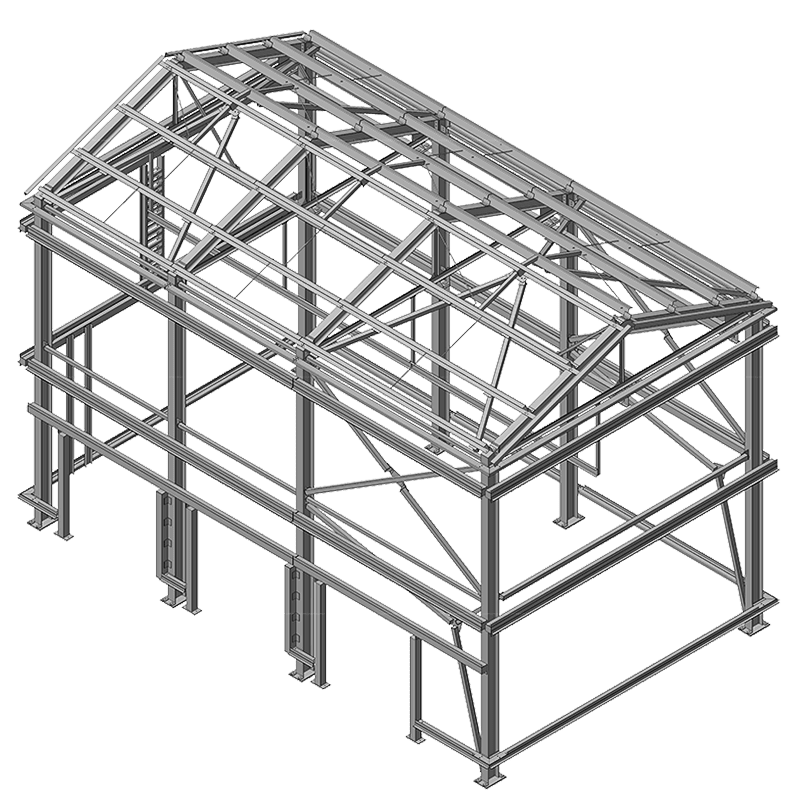
The basis of a metal frame is a **transverse frame**, which consists of columns connected to the foundation, and a **truss (rafter) system** hinged to the columns. All loads on the structure are distributed between the columns and the truss. The primary loads are borne by the columns: loads from self-weight, wind loads, precipitation loads, and crane loads. Loads from the building's roof and from connections between columns are transferred to the **trusses**, which have a lattice structure to increase roof rigidity.
The elements of a metal building or structure frame also include:
• **Welded beams** of constant or variable cross-section, the size of which can increase building spans.
• **Frame columns**, which increase the rigidity of the frame structure.
• **Girders**, which are linear load-bearing elements connecting column posts and supports. In practice, girders bear significantly high loads, and they can be used to increase building spans and ceiling heights.
• **Crane runway structures**, beams with T-shaped or I-beam cross-sections, increasing the rigidity of the section and the load-bearing capacity of the entire structure for installing overhead cranes.
• **Bracing**, used for connecting metal structure elements (bolted, riveted, welded).
• **Purlins**, which are bracing elements that attach roof and wall structures to the building or structure frame; they bear snow and wind loads.
• **Embedded parts**, designed for welding structures together.
• **Fasteners**, hardware.
• **Arches** (an arched span between the purlins of a building or structure).
The **spatial rigidity** of a building or structure frame is achieved by a bracing system of frames, columns, and trusses.
**BRACING SYSTEM FOR METAL FRAME ELEMENTS**
To assemble building and structure elements into a unified frame, various **bracing systems** are used, which ensure the **spatial rigidity and geometric immutability of the frame**.
Since the elements of a building frame can be located in vertical and horizontal planes, the connections between elements can be:
• **Vertical bracing** between columns.
• **Horizontal bracing** along the top chord of trusses and beams (transverse, longitudinal, pitched).
There are several types of connections between frame elements:
• **Frame scheme of a building frame**: a combination of a rigid and stable system of columns, girders, and floor slabs, where load-bearing elements are joined by rigid nodal connections, and all loads are borne by the transverse and longitudinal frames.
• **Braced frame scheme of a building** with simple structural solutions for connecting columns and girders with movable fasteners that only bear horizontal loads.
• **Frame-braced scheme of a building frame**, where vertical bracing is perpendicular to the frame members, with transverse wall diaphragms and rod elements, where the frame and rigidity diaphragm absorb lateral loads.
• **Combined metal frames**.
**FRAME AND TRUSS SYSTEMS OF A BUILDING OR STRUCTURE FRAME**
Metal frames of buildings and structures are classified into **frame and truss structural systems** based on the type of steel frame:
• **Frame systems**, where all loads are borne by the longitudinal and transverse frames.
Frame structures consist of steel I-beams (beams), rigidly connected at the corners, forming a frame. In such systems, the frame consists of vertically arranged frame supports-columns and horizontal girders that bear the load of floor slabs.
Truss systems of floor trusses (or beams), in which steel rods form triangles, creating half-timbered panels (or fields). These fields form half-timbered trusses that serve as the base for the roof. They are connected to the steel columns of the frame by welding or bolts.
There is a method of constructing buildings and structures from **light metal structures**, which appear as parallel flat metal frames installed on a foundation. The frames are connected by struts or bracing, purlins, and inter-floor beams (in the case of multi-story buildings). Purlins serve to attach wall and roof structures to the building frame. Light metal structural elements are either bolted or welded, which determines the degree of factory readiness of the metal structure (welding is carried out at the factory, bolting at the installation site).
**ENSURING RELIABLE OPERATION OF THE BUILDING FRAME**
Frames, buildings, structures, canopies
All structural elements of a metal frame must possess high **corrosion resistance** and low **fire resistance**. To reduce fire resistance, special **heat-insulating screens** are applied to the surface of structural elements, which slow down the heating of the metal: plaster, intumescent paints, or fire-retardant coatings. To increase resistance to adverse external factors, the metal structures of the building frame are treated with paint and varnish coatings, polyethylene powder coatings, metallization coatings, and rubberizing of surfaces (application of rubber compounds and mastics).
For quality application of anti-corrosion coating, TOO SAMRUK KAZ prepares the surface using **sandblasting, shot blasting, and chemical cleaning methods**.
TOO SAMRUK KAZ manufactures **metal frames for buildings of any type and purpose**. The type of building or structure frame is selected based on the Customer's requirements for the metal structure. All metal structures produced at the TOO SAMRUK KAZ factory are distinguished by their high quality, which ensures their long service life and safety.
TOO SAMRUK KAZ is a modern industrial enterprise focused on: • Designing and developing engineering documentation for oil depots, tank farms, pipeline routes, various metal structures, and non-standard equipment; • Manufacturing metal structures, tanks, and vessels for various purposes (Vertical Steel Tanks (RVS), Horizontal Steel Tanks (RGS), Underground Tanks (UT)) in both above-ground and underground configurations with necessary equipment installation, as well as producing metal structures for buildings, constructions, railway overpasses, and supports for technological pipelines using various materials (alloyed and high-alloyed steel, stainless steel, aluminum alloys, etc.); The company has a logistics department that ensures a continuous construction cycle, allowing for the timely delivery of necessary equipment and machinery to the customer. Delivery is provided upon the customer's request as part of a comprehensive service package for the production and installation of tank and vessel equipment. The cost of services is calculated individually. You can learn more about TOO SAMRUK KAZ's production capacities in the "Production" section.
Year of foundation
tanks produced
vessels produced
metal structures produced
TOO SAMRUK KAZ is a manufacturer providing comprehensive supplies of tanks for various purposes, as well as tank equipment for the oil and gas, energy, chemical, and other industries.

The company has many years of experience in manufacturing and designing industrial equipment.

We utilize the most advanced industrial equipment for manufacturing and guarantee the highest quality of our products.

We deliver equipment on time. We have a well-established production and logistics structure.